
How to Do a Keyword Gap Analysis
- Jorge Melo
- Nov 30, 2025
- 6 min read
By Jorge Melo
If your competitors keep showing up above you in Google, it is rarely an accident. It usually comes down to one thing: keywords. A keyword gap analysis shows you exactly which search terms your competitors rank for that you do not. This gives you a clear path to improve your rankings, sharpen your inbound marketing and SEO strategy, and attract the right visitors. Many businesses guess which keywords matter. This process replaces guessing with data so your content works smarter, not harder.
A keyword gap analysis is a review of the keywords your competitors are winning and the ones you are missing. It helps you discover new opportunities, weak pages, and low difficulty keywords that can bring quick results. It supports basic SEO services and long-term content planning. Whether you are an accountant, contractor, or any local service business, this analysis makes it easier to choose practical terms instead of wasting time on high difficulty keywords that do not fit your current authority.
Master Keyword Gap Analysis
Keyword gap analysis vs. content gap analysis
A keyword gap analysis focuses on specific search terms. A content gap analysis focuses on broader topics and customer questions.
Both matter, but the keyword version gives clearer, faster steps to guide new content and improve existing pages without keyword stuffing or guesswork.
Why perform a keyword gap analysis?
A keyword gap analysis is useful because it helps you:
Find the keywords competitors use to outrank you
Identify weak pages that need more clarity or stronger structure
Discover missing keywords that are easy to win
Support basic SEO services and technical SEO audit services
Guide new content ideas without wasting time
Find seo keywords for accountants or any industry
Strengthen inbound marketing and SEO
Improve both SEO and paid search decisions
This creates efficient keyword SEO secrets that support long-term growth.
How to do a keyword gap analysis
1. Select competitors for your analysis
Choose two to five competitors with strong organic visibility. Your real competitors online are the websites above you in Google, not just the businesses you compare yourself to in person.
2. Find your keyword gaps
We prefer to use SEMrush. Enter your domain and your competitor domains. These tools reveal:
Missing keywords
Weak keywords
Shared keywords
Strong keywords
This shows you exactly where you are losing ground.
3. Analyze your keyword gaps
Review each keyword for:
Difficulty
Search volume
Intent
Relevance
Target low difficulty, clear intent keywords when your site has lower authority. This matters for accountants, landscapers, cleaning companies, and other service-based businesses trying to grow in competitive towns.
4. Select and save relevant keywords
Export your keyword lists and organize them. Remove irrelevant terms, merge similar ones, group them by service, and focus on the ones that align with your business goals.
5. Group keywords
Group keywords into topic clusters. This helps create organized content, avoids overlapping pages, and supports mobile SEO services, stronger user experience, and long-term ranking.
6. Create new content and optimize old content
Weak keywords = update the existing page. Missing keywords = create new content.
Make sure your content is clear, structured, and helpful. Use simple, clean writing and avoid seo keyword stuffing.
7. Monitor your ranking changes
Use a keyword monitor tool to track progress. Review rankings regularly and update pages based on performance. This keeps your inbound marketing and SEO strategy evolving.
Find keyword opportunities you’re missing out on
Keyword gap tools reveal low hanging fruit keywords for SEO. These are easy-to-rank terms your competitors already win. Targeting these helps small and mid-sized businesses gain visibility without relying on high competition search terms that take years to rank for.
Do SEO keywords need to be exact?
No. Search engines understand variations. The goal is clarity, not forcing a perfect match.
How to steal competitors keywords
You “steal” keywords by outperforming competitors. You do this by:
Writing clearer, more helpful content
Structuring pages with stronger headers
Improving user experience
Adding internal links
Fixing technical issues with a technical SEO expert
Improving the value of the page
Better pages beat weak pages every time.
How many key words on a page?
Focus on one primary keyword per page with several natural variations. Too many keywords confuse search engines and weaken your message.
What to do after keyword research
After your research, you should:
Plan content
Update older pages
Build internal links
Improve meta tags
Structure pages with stronger headings
Run technical SEO audit services
This ensures that your content strategy and technical performance support each other.
What is keyword bidding?
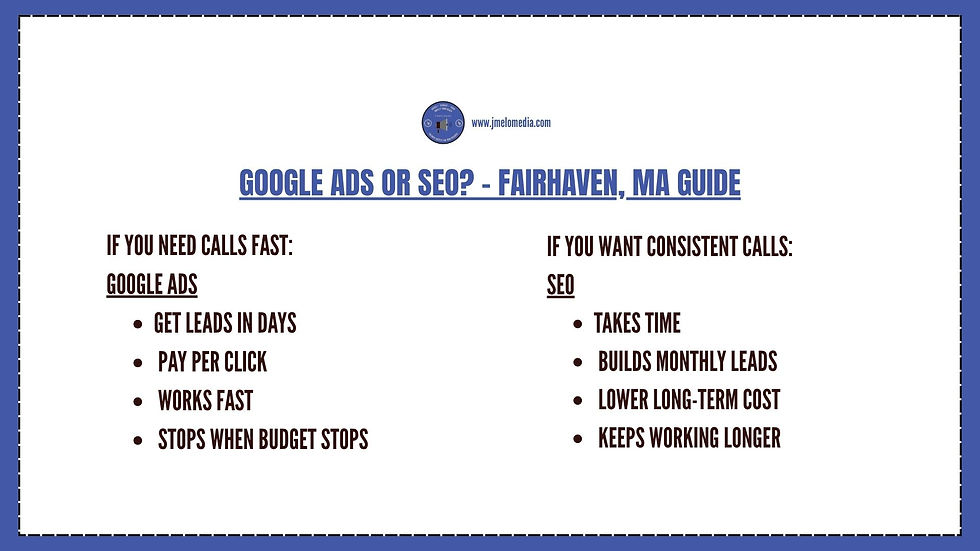
Keyword bidding is a paid search method (ex: google ads) where you decide how much you are willing to pay per click. Businesses that run both SEO and SEM services in New Bedford, MA or SEM services in Fairhaven, MA can use keyword gap insights to lower costs and boost conversions.
What are low hanging fruit keywords for SEO?
These are low difficulty, relevant keywords that can rank quickly. They are ideal for newer sites or businesses that want early wins before targeting harder terms.
What is a keyword monitor?
A keyword monitor is a tool that tracks your rankings in search engines over time. It helps you understand your movement and guides updates.
Is high keyword difficulty good?
High difficulty keywords are not always ideal. They take more time, more authority, and
more backlinks. For many local service businesses, it makes more sense to target moderate or low difficulty terms first.
Case study: New England Tree and Landscape’s growth with J Melo Media
When New England Tree and Landscape first came to us, their situation was challenging. They were paying more than two hundred dollars per month for basic website hosting with a provider that was not doing updates, not improving SEO, not running any marketing, and not communicating with them. The site was outdated, slow, and not designed for growth.
We rebuilt the entire site from scratch. Clean layout. Better navigation. SEO friendly structure. A more visually appealing design that customers immediately appreciated.
Then we launched a full SEO done for you strategy that included:
Eight blog posts per month
Backlinks
Local SEO
Technical improvements
Keyword research and clustering
On-page updates
Within the first two to three months, their traffic increased significantly. They went from not being on the first page at all to consistently outranking every competitor in their area.
When the owner asked to rank for “hardscaping” and “lawn maintenance,” they had zero visibility for those terms. After two weeks of targeted optimization and keyword gap analysis, they ranked number one locally for both keywords.
Since then, their growth has continued. They have increased their domain authority, and they are now ranking on the first page of Google for nearly all of their service keywords in their local area. They are even ranking number one for several of them. The steady flow of new customers finding them online is a direct result of the strategy we built.
Advanced advertising options for business growth
In addition to SEO, we run sophisticated Meta and Google ad campaigns. This helps businesses pair organic growth with strong paid visibility. It is a powerful combination for companies looking for the best local SEO services in Fairhaven, MA or the best local SEO services in New Bedford, MA.
FAQ about keyword research
How often should I update my keyword strategy?
Every three to six months.
Should I go after high volume keywords?
Only if they match your authority level. Low competition keywords often produce faster returns.
Should multiple pages target the same keyword?
No. Each page should target a unique purpose.
Do long tail keywords matter?
Yes. They carry strong intent and often convert better.
FAQ about J Melo Media
Do you offer full SEO done for you services?
Yes. We manage everything from strategy to execution.
Can you help service businesses like accountants, landscapers, or cleaners?
Yes. We specialize in service-based industries.
Do you build websites?
Yes. We deliver fast, clean, SEO friendly websites.
Do you manage paid ads?
Yes. We run advanced Meta and Google campaigns.
Ready to improve your rankings? Contact J Melo Media at Jorge@jmelomedia.com or 508-972-1223 or visit www.jmelomedia.com.
Sources
Semrush. “Keyword Gap Analysis: What It Is & How to Do It.” Semrush Blog, 2024.Surfer. “Master Keyword Gap Analysis in 6 Steps.” Surfer SEO Blog, 2024.BrightEdge. “Use Competitive Analysis to Rank Higher in Search Results.” BrightEdge Blog, 2020.Loganix. “Keyword Gap Analysis.” Loganix.com, 2025.Tuff Growth. “How to Do a Keyword Gap Analysis.” TuffGrowth.com, 2023.


Really helpful guide on keyword gap analysis! The clear steps make it easy to identify content opportunities. Great resource for anyone working on Local SEO Brisbane and improving search visibility.