
Are Google Local Service Ads Worth It in Fairhaven, MA?
by Jorge Melo | J Melo Media | jmelomedia.com
Fairhaven had 16,005 residents in 2024, and 74.4% of its housing was owner-occupied in the 2020 to 2024 Census period. That gives roofers a homeowner-heavy market where one good call can turn into real revenue fast.
Google Local Services Ads give roofers a chance to show up prominently when homeowners are ready to hire, and you only pay when someone calls you for an estimate, instead of paying for every click.
That is the part worth caring about. A Fairhaven roofer can pay for calls, messages, and booking requests from people actively looking for help, not just for traffic that may never turn into work.
For many roofers in Fairhaven, MA, LSAs are worth it when the company has strong reviews, answers calls quickly, and targets nearby South Coast towns instead of relying on Fairhaven alone.
When reviews are weak, response times are slow, or service areas are set up poorly, results can drop fast.
J Melo Media can handle that system for you by managing the LSA account, tightening your Google Business Profile, helping you get reviews, supporting local SEO, and improving call handling so more paid leads turn into booked jobs.
What are Google Local Services Ads?
Google Local Services Ads are a paid advertisement product built specifically for local service businesses.
A homeowner searches for a roofer, Google shows a short list of nearby companies with reviews and a trust badge, and the homeowner picks one to call. You only pay when someone contacts you, not when they scroll past.
How they work for roofing leads
The appeal for roofers is that LSA leads tend to come from people who are further along in the decision. Someone calling through an LSA usually wants to schedule an estimate or get help with an active problem.
That is different from someone clicking a website out of mild curiosity. The conversion path is shorter, which matters when you are paying per contact.
Google also lets you dispute bad leads. If someone calls about a service you do not offer, from a town outside your area, or in a way that does not meet Google's criteria, you can submit it for review and potentially get credited back.
In a smaller market like Fairhaven, where lead volume may not be huge, that dispute process is worth understanding and using.
Where they show up in Google Search
LSAs appear in Google Search, but the page has gotten more crowded. AI Overviews now appear on many searches, and depending on the query, LSAs may sit below them or alongside other features.
For a roofer covering Fairhaven and nearby towns, this is one reason local SEO still matters alongside LSAs.
Google summarizes roofing options in an AI Overview before the user ever reaches an ad, so your Google Business Profile, reviews, and service pages all feed into how your business looks in that summary.
For direct searches like "roofer in New Bedford" or "roof leak repair near me," LSAs still tend to show up prominently and those searches carry strong buying intent. That is where the channel holds its value.
Why Local Services Ads can work well for roofers in Fairhaven, MA
Top-of-page visibility for local roofing searches
When someone searches for a roofer on their phone after finding a leak or spotting storm damage, the businesses at the top of the page get the first calls. Most people do not scroll much on mobile before they tap.
For a roofer who wants to compete across Fairhaven, New Bedford, and the surrounding South Coast towns, that placement is genuinely valuable. LSAs can get you there without requiring a high-performing website or years of organic SEO work.
Pay per lead instead of pay per click
Standard Google Ads charge for clicks. A homeowner in Acushnet clicks your ad, looks at your site for 20 seconds, and leaves. You still paid for that visit.
LSAs charge for leads. The homeowner has to actually call you or send a message before Google counts it. For a roofing company that sells primarily over the phone or during an in-person estimate, that model fits the way jobs actually get booked.
Trust signals that help homeowners choose faster
Roofing is not a low-stakes purchase. A homeowner comparing roofers is looking for reasons to feel comfortable before they let someone on their roof and hand over a significant check.
The Google Verified badge, combined with your review count and star rating in the ad, does some of that trust-building before they even reach your website.
In a smaller market like Fairhaven, where the number of options is more limited, that shortlist dynamic tends to move faster.
Coverage across Fairhaven and nearby South Coast towns
Fairhaven alone probably does not generate enough roofing search volume to make LSAs consistently worthwhile on its own.
The value improves when you expand your service area to reflect where you actually want work: New Bedford, Dartmouth, Acushnet, Mattapoisett, Rochester, Marion, and Wareham are all reasonable additions depending on where your crews operate.
A Fairhaven mailing address does not mean you have to limit your visibility to only Fairhaven.
How much do Local Services Ads cost roofers in Fairhaven, MA?
Average cost per lead
There is no fixed roofing lead cost for this market. Google does not publish rates by town, and any national average you find in an article is not going to tell you much about what a lead will actually cost a roofer covering Fairhaven and nearby parts of the South Coast.
What Google does say is more useful for planning: advertisers should budget for at least 10 leads per week for the system to learn properly, and it typically takes about two weeks before bidding results settle into a reliable pattern.
The practical takeaway is that very small budgets often struggle, especially when your service area is limited. If you are only targeting Fairhaven with a $300 monthly budget, the volume will likely be too low to see consistent results.
Broadening the area and setting a more realistic budget improves the odds considerably.
Why lead costs change by season, competition, and job type
Roofing demand on the South Coast does not stay flat. A quiet January in Fairhaven looks completely different from the week after a strong nor'easter hits New Bedford or Marion.
Emergency leak calls and storm damage inquiries come in clusters. When demand spikes, competition for those leads can increase too, which tends to push up cost per lead.
Estimate-based jobs for full replacements can produce higher-ticket work, but homeowners often spend more time comparing options before they book, which means those calls take longer to convert.
Budgeting with Maximize Leads and Target CPL
Google offers two main bidding options for LSAs.
Maximize Leads is the default and is generally where roofers should start.
Target CPL is an optional layer that lets you set a maximum you are willing to pay per lead.
Google calculates your monthly maximum by multiplying your average weekly budget by the average number of weeks in a month, so the weekly number you set has a real effect on total monthly spend.
For a roofer covering a wide enough service area on the South Coast, the system tends to perform better when it has enough lead volume to learn from rather than being throttled by a very tight budget from the start.

The biggest problems roofers run into with Local Services Ads
Bad or irrelevant leads
The most common frustration is paying for leads that go nowhere. Calls for the wrong type of work, from towns you do not want to serve, or from people still comparison shopping with no intention of booking soon.
This is often a setup problem more than a platform problem. If your service area is too broad, you attract calls from places you did not mean to include. If your job types are not configured accurately, you get inquiries for services you do not offer.
Tightening those settings and using the dispute process for genuinely invalid leads can make a noticeable difference.
Limited control over targeting
LSAs are simpler than standard Google Ads, and that simplicity has a cost. You cannot manage bids at the keyword level, write your own ad copy, or direct traffic to a specific landing page.
The profile is the ad. That works fine when the profile is strong, but it means a roofer who wants to test different messages, target specific job types with precision, or send storm damage leads to a dedicated page will hit the ceiling of what LSAs can do.
Missed calls and slow response times
This one matter more than most roofers expects. Google uses responsiveness as a factor in LSA ranking.
Miss enough calls and your ad visibility can drop. In a smaller market like Fairhaven and the surrounding South Coast area, where the total lead volume may not be that high to begin with, missing even one good call from a homeowner ready to book is a real cost.
If the owner is on a roof and the office is not staffed, those calls go to voicemail and often do not get returned.
That pattern is one of the fastest ways to make LSAs feel like they are not working when the real issue is calling handling.
Dependence on reviews and Google's ranking system
Google weighs review count, star rating, responsiveness, and profile completeness when deciding which roofers show up higher in the LSA unit.
A roofer can outspend a competitor and still rank below them if the competitor has a stronger profile and better reviews.
That is worth understanding before you put money in. More budget does not automatically fix a weak profile.
What makes Local Services Ads worth it for some roofers and not others
Strong reviews and a complete profile
Google requires a minimum number of reviews for a business to go live on Search through LSAs. Going live is not the same as performing well.
A roofer with five reviews and a 4.2 average is going to struggle against a competitor with 40 reviews and a 4.9 average in the same Fairhaven or New Bedford search result.
The businesses that do well with LSAs usually have a steady flow of recent positive reviews, not just a strong average from a while back. Recency matters because homeowners notice when the last review was posted.
Accurate service areas and job types
The service area and job type settings in your LSA profile are not just administrative boxes to fill in.
They directly affect who sees your ad and what kinds of leads come through. A roofer covering Fairhaven, Dartmouth, and Acushnet who leaves their service area set to a 50-mile radius will get calls from places they never intended to serve.
Setting these correctly saves money and improves lead quality without changing the budget at all.
Fast lead response and solid call handling
LSAs are built around direct contact. The whole premise is that a homeowner reaches out and you respond. When the phone rings at 7 PM on a Wednesday because someone in Marion spotted wind damage on their roof, the roofer who answers gets the job.
The one who lets it go to voicemail usually does not, because homeowners tend to call the next name on the list rather than wait.
If answering every call is not realistic during busy periods, an answering service or AI phone assistant is worth the investment to protect the leads you are already paying for.
Support from local SEO, Google Business Profile, and call tracking
LSAs perform better when they are not carrying the whole lead load alone. A complete, well-optimized Google Business Profile feeds trust signals directly into your LSA ad.
Local SEO work means that homeowners who do not click an ad still find you in the map results. Call tracking lets you see which leads actually turned into booked jobs, so you are not just guessing whether the channel is working.
Most Fairhaven-area roofers who get real value from LSAs have this combination working underneath them, even if they do not think of it that way.
J Melo Media's marketing services are built around exactly this kind of setup: LSA management, Google Business Profile optimization, local SEO, and call handling support working together for South Coast service businesses.
Local Services Ads vs Google Ads for roofers
Leads vs clicks
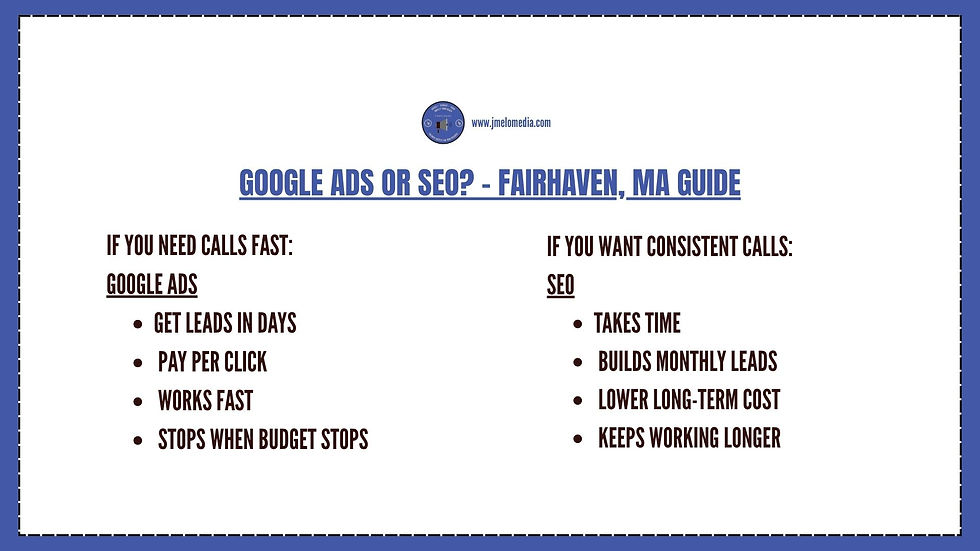
The core difference is what you pay for. Google Ads charges when someone clicks. LSAs charge when someone contacts you. For a roofer who books most jobs over the phone, paying for calls and messages tends to feel more direct than paying for website traffic that may or may not convert.
That said, clicks still have value when they land on a page built to handle the right kind of inquiry, like a storm damage response page or a financing explainer.
Placement and search intent
LSAs are strongest on the highest-intent local searches, the ones where the homeowner has already decided they need a roofer and just needs to pick one. Google Ads can cover a wider range of intent, including more specific searches, comparison queries, and job-type searches that do not always trigger the LSA format.
If a homeowner in Wareham is searching for "standing seam metal roofing installation" instead of "roofer near me," a Google Ads campaign can reach that search in ways LSAs may not.
Control, tracking, and landing pages
Google Ads gives you more control. You write the ads. You choose the keywords. You direct traffic to a landing page built for a specific job type or seasonal offer. You can layer in call tracking, enhanced conversions for leads, and eventually booked-job attribution so you know exactly what the channel produced.
LSAs are simpler, which makes them easier to run, but that simplicity means giving up the ability to fine-tune at the keyword and landing page level. Neither option is automatically better. They serve different situations.
When using both together makes more sense
For most roofing companies covering Fairhaven and the surrounding South Coast, the strongest paid setup is usually both channels working together rather than one replacing the other.
LSAs handle the highest-intent direct-contact searches. Google Ads fills in gaps, covers more specific queries (if you want to target commercial jobs for example), and drives traffic to pages that can explain services, handle storm damage calls, or walk someone through the estimate process.
When call tracking ties everything back to actual booked jobs, the business can see clearly what is worth paying for and what is not.
Are Local Services Ads a good fit for roofers in Fairhaven, MA?
When LSAs are worth it
LSAs tend to work well for a Fairhaven-area roofer when the company already has a strong Google Business Profile, a solid review base, a service area that reflects where they actually want work, and a reliable system for answering leads quickly.
In that setup, the pay-per-lead model combined with top-of-page visibility can produce a consistent flow of qualified calls across New Bedford, Dartmouth, Acushnet, and other nearby towns.
When Google Ads or local SEO may be the better first move
If reviews are thin, the profile is incomplete, or calls routinely go unanswered, investing in LSAs before fixing those problems tends to produce disappointing results. The leads come in, they do not convert well, and the channel gets written off unfairly.
In that situation, getting local SEO and the Google Business Profile into better shape first is usually the higher-leverage move.
Google Ads is also worth considering if you want tighter control over search terms, landing pages, and tracking before committing to LSAs long term.
The best setup for most roofing companies in this area
For most roofers serving Fairhaven, New Bedford, Dartmouth, Acushnet, Mattapoisett, and nearby South Coast towns, the setup that tends to work best is a combination.
Local SEO and a strong Google Business Profile build long-term visibility and trust.
LSAs create top-of-page paid opportunities when homeowners are ready to call. Strong call handling makes sure those leads do not disappear into voicemail.
That combination is usually what makes LSAs worth the cost here, not LSAs running alone without anything else supporting them.
Frequently asked questions about Local Services Ads for roofers in Fairhaven, MA
Are Google Local Services Ads worth it for roofers, plumbers, and HVAC companies in Fairhaven, MA?
They can be, but the answer depends on the business, not just the channel. A roofer with strong reviews, a complete profile, and someone answering calls is in a good position to get real value from LSAs. A roofer running them with a weak profile and no call handling usually does not. For plumbers and HVAC companies in Fairhaven, the same logic applies. The channel rewards businesses that are already operating well, not ones hoping the ads will fix underlying problems. Our marketing services include LSA management alongside the profile and SEO work that actually makes the ads perform.
How much does a roofing, plumbing, or HVAC lead usually cost through Local Services Ads?
There is no fixed rate for Fairhaven or the South Coast. Lead costs vary based on your service category, how competitive the search market is, your service area size, and your profile strength. Google recommends budgeting for at least 10 leads per week for the system to learn effectively. Very small weekly budgets in narrow service areas often produce too little volume for the algorithm to optimize well. The right number depends on your specific situation and service area.
Do Local Services Ads work better for emergency calls or larger estimate-based jobs?
LSAs tend to perform strongest for high-intent direct-contact searches, which often includes emergency calls and urgent repair requests. A homeowner with an active leak in New Bedford is more likely to call the first result than compare several options. Larger estimate-based jobs involve more comparison shopping, which can reduce the advantage of top-of-page placement. Both job types can come through LSAs, but emergency and urgent calls tend to convert more quickly.
What makes one roofer rank above another in Local Services Ads?
Google weighs review count, star rating, responsiveness, profile completeness, and budget together. A roofer with more positive recent reviews, a complete and accurate profile, fast call response, and a realistic budget tends to rank higher. Spending more does not override a weak profile. Reviews and response speed are often the bigger factors, especially in a smaller market like Fairhaven where the competitive set is more limited.
How many Google reviews does a service business need before Local Services Ads start working well?
Google requires a minimum number of reviews to go live, and its optimization guidance recommends at least five. Going live is not the same as performing well. In a market where homeowners are comparing a short list of local roofers, five reviews will rarely outperform a competitor with forty recent, positive reviews. There is no magic number, but more recent reviews with strong ratings consistently produce better LSA results than a thin review history.
Can a Google Business Profile help Local Services Ads perform better?
Yes. Your Google Business Profile and your LSA profile are connected, and strong GBP feeds trust signals into your ad. Consistent business information, accurate service categories, recent photos, and a steady review flow all contribute. A roofer in Dartmouth or Acushnet with a well-maintained GBP is starting from a better position than one with an incomplete or outdated profile. Local SEO work and GBP optimization are usually the foundation that makes LSAs worth running.
What should a roofer do about bad or irrelevant Local Services Ads leads?
Dispute them through Google's lead dispute process. If a lead does not meet Google's qualifying criteria, you can flag it for review and potentially receive a credit. More importantly, review your service area and job type settings to prevent the same types of bad leads from coming in again. A roofer getting calls from towns they do not serve or for work they do not do usually has a setup problem, not a platform problem. Tightening the settings is the right first step.
Should service businesses in Fairhaven target only Fairhaven, or nearby towns too?
Nearby towns almost always. Fairhaven alone does not generate enough search volume in most service categories to make LSAs consistently worthwhile. Expanding to include New Bedford, Dartmouth, Acushnet, Mattapoisett, Marion, Wareham, and Rochester gives the algorithm more demand to work with and the business more realistic lead volume. The service area should reflect where you actually want to work and can send a crew, not just the town where your office is.
What happens if a service business misses Local Services Ads calls or responds too slowly?
Google uses responsiveness as a ranking factor for LSAs. Consistent missed calls can lower your ad ranking, which reduces visibility, which reduces leads, which makes the whole channel look like it is not working. In a smaller South Coast market where lead volume is already more limited than in Boston or Providence, losing one good call to voicemail matters more. If answering every call is not practical, an answering service or AI phone assistant can prevent the pattern from compounding.
Can roofers run LSAs and Google Ads together?
Yes, and for many South Coast roofing companies it makes sense. LSAs cover the highest-intent direct-contact searches. Google Ads can fill in other search queries, support specific job types, and drive traffic to landing pages with more detail. When both channels are tracked properly, including call tracking, enhanced conversions for leads, and eventually booked-job attribution, a roofer can see clearly what each channel is actually producing and allocate budget accordingly.
When is local SEO just as important as Local Services Ads for service businesses?
Almost always. LSAs create paid visibility at the top of the page. Local SEO creates organic visibility in the map pack and in regular search results. A homeowner who does not click an ad may still find you through the map results if your local SEO is solid. Beyond that, a strong Google Business Profile, consistent NAP information across the web, and well-built service pages all feed into how trustworthy your business looks to Google, which in turn affects how your LSAs perform.
Should a service business use an answering service or AI phone assistant for Local Services Ads calls?
If calls are regularly going to voicemail, yes. An answering service or AI phone assistant can handle LSA calls during off-hours, busy job periods, or any time the owner or office staff cannot pick up. The cost of a missed lead is real, and in a smaller market like Fairhaven or surrounding South Coast towns, it tends to be higher because lead volume is more limited to begin with. Protecting the leads you are already paying for is usually worth the added cost of live call coverage.
How do you dispute an invalid lead in Local Services Ads?
Go to your LSA dashboard, find the lead, and select the dispute option. Google reviews it and may issue a credit if it came from outside your service area, was for the wrong service, a duplicate, or not a real inquiry. You have 30 days to submit disputes, so reviewing leads regularly protects your budget.
How much should a roofer budget for Local Services Ads each month?
Google recommends budgeting for about 10 leads per week so the system can learn and optimize. If leads cost around $60 to $100, that puts most roofers in the $2,400 to $4,000+ monthly range. A budget that’s too small limits volume and makes performance look worse than it actually is.
Ready to find out if LSAs are worth it for your roofing company?
If you are losing calls to voicemail, getting uneven lead flow, or watching competitors show up higher in Google while your business sits further down the page, those are fixable problems.
J Melo Media manages Local Services Ads and Google Ads for service businesses across the South Coast, and we build the local SEO and Google Business Profile work underneath that makes the ads actually perform.
Contact us for a review of your current visibility, profile strength, and lead-handling setup. We will show you where you stand and what is worth doing first.
Email Jorge@jmelomedia.com or call (508) 501-7906
Related articles
Sources
U.S. Census Bureau. QuickFacts: Fairhaven town, Bristol County, Massachusetts. https://www.census.gov/quickfacts/fact/table/fairhaventownbristolcountymassachusetts/PST045224
Google. Getting started with Local Services Ads. https://support.google.com/localservices/answer/6224841
Google. Overview of Local Services Ads. https://support.google.com/localservices/answer/7549347
Google. About Google Verified. https://support.google.com/localservices/answer/16498018
Google. About Google Screened. https://support.google.com/localservices/answer/9376654
Google. About Local Services Ads ranking. https://support.google.com/localservices/answer/7496631
Google. About Local Services Ads responsiveness. https://support.google.com/localservices/answer/7527305
Google. About Maximize Leads and Target CPL. https://support.google.com/localservices/answer/10125017
Google. About Target CPL bidding. https://support.google.com/localservices/answer/15406075
Google. How leads work for Local Services Ads. https://support.google.com/localservices/answer/7195435
Google. Message leads for Local Services Ads. https://support.google.com/localservices/answer/12492201
Google. Service areas and job types. https://support.google.com/localservices/answer/7419052
Google. Reviews and Ratings on Local Services Ads. https://support.google.com/localservices/answer/7496631
Google. Business screening and verification requirements, United States. https://support.google.com/localservices/answer/12174778?co=GENIE.CountryCode%3DUS&hl=en
Google Search Help. Find information in faster and easier ways with AI Overviews in Google Search. https://support.google.com/websearch/answer/14901683
Google. Expanding AI Overviews and introducing AI Mode. https://blog.google/products/search/ai-mode-search/
Google. More opportunities for your business on Google Search. https://blog.google/products/ads-commerce/google-search-ai-brand-discovery/


Comments