
Should I use Google Ads or SEO for my Fairhaven, MA business?
By Jorge Melo | J Melo Media | April 19, 2026
98% of consumers used the internet to find a local business in the past year (BrightLocal, "Consumer Search Behavior," 2025).
If your phone is not ringing the way it should, and you already have a website and a Google profile live, something in your online presence is not working the way you think.
So which one is the fix? Google Ads or SEO?
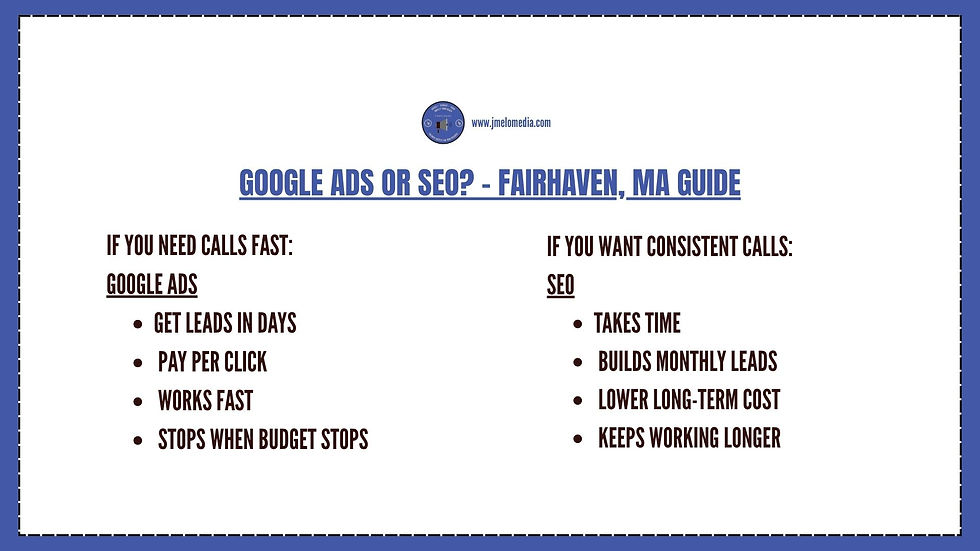
Here is the direct answer. If you need calls this month, Google Ads can get you there faster. If you want your business to keep showing up on Google without paying for every click, local SEO builds that over time.
For most service businesses in New Bedford and across the South Coast, the right answer is both. But which one you start with depends on your budget, how fast you need leads, and where your Google presence stands today.
This guide breaks both down so you can decide.
What are Google Ads and how do they work?
Google Ads is a paid advertising platform that lets your business show up at the top of Google search results.
You bid on keywords, and when someone searches one of those terms, your ad can appear above the organic results. You pay each time someone clicks (Google, "SEO vs. PPC," 2024).
That is the basic version. Here is what makes it useful for a local service business.
Say a homeowner in Fairhaven searches for "AC repair near me" on a hot July afternoon.
Your ad can be the first thing they see. No waiting months for organic rankings. No hoping your profile shows up in the map pack. You are there, right now, at the top of the page.
Google also reports that businesses average $2 in revenue for every $1 spent on Google Ads (Google, as cited in SEMrush, 2024). That ratio is real, but only when the setup is right.
Weak targeting, a poor landing page, or no way to track which clicks turned into booked jobs will drag that number down fast.
What Google Ads do not do
Running Google Ads does not improve your local search ranking or your position in Google Maps. Google has stated this clearly: paid ads have no effect on organic rankings (Google Business Profile Help, 2024).
If your goal is to show up without paying per click, you need SEO. The two systems are completely separate.
The real downside of Google Ads
The moment you stop paying, the visibility disappears. There is no residual. No asset built. That is fine if you are using ads strategically, but it is a problem if ads are the only thing driving your leads.
Studies also show that the majority of people still click the organic results, not the paid ads, when both are present (Sevell, 2024). Paid ads catch some of that traffic at the top.
Organic results catch more over time.
What is local SEO and what does it build?
Local SEO is the practice of making your business show up in Google's organic results and map listings when someone nearby searches for your service. There is no cost per click. But it takes time, and it requires consistent work to build and maintain (Google, "SEO vs. PPC," 2024).
Think of local SEO as building an asset. The work you put in today keeps producing leads six months from now, even if you stop actively working on it for a while. That is the core difference between SEO and ads. Ads are rented visibility. SEO is owned visibility.
How local SEO works for a South Coast service business
When someone in Dartmouth searches "plumber near me," the businesses that appear in the top three map results have all done the same things. Their Google Business Profile is complete and active.
Their website has clear pages for each service they offer. Their business name, address, and phone number are consistent everywhere online. And they have a steady stream of recent reviews from real customers.
According to Pathlabs, SEO delivers a conversion rate of around 2.4%, compared to roughly 1.3% for Google Ads (Pathlabs, 2024).
Over time, that gap compounds. More visits from organic search, each converting at a higher rate, adds up to a lower cost per lead than paid traffic alone.
Why local SEO takes time
SEO typically requires three to six months before you see meaningful results (Sevell, 2024). Some businesses see movement sooner. Some take longer. The pace depends on how competitive your market is, how strong your existing profile and website are, and how consistently the work is done.
That timeline is real. It is also why businesses that treat local SEO as a long-term asset rather than a short-term fix get the best results from it.
Our local SEO services in New Bedford are built around this reality. We do not promise overnight rankings. We build the foundation that keeps producing leads after the initial work is done.
Google Ads vs. local SEO: a side-by-side comparison
Here is how the two channels stack up for a service business across the South Coast of Massachusetts.
Factor | Google Ads | Local SEO |
How fast does it work? | Days to weeks | 3 to 6 months typically |
Do I pay per click? | Yes | No (requires ongoing investment) |
Does it improve my map ranking? | No | Yes |
Does visibility stop when I stop spending? | Yes | No |
Can I target specific towns? | Yes, but small radius can choke delivery | Yes, with location-specific pages |
Average conversion rate | Around 1.3% | Around 2.4% |
Best for getting calls fast? | Yes | Not immediately |
Best for long-term visibility? | Not on its own | Yes |
Works better with a strong Google Business Profile? | Yes | Yes |
ROI timeline | Immediate (if converting) | 6 to 12 months typically |
Conversion rate data sourced from Pathlabs (2024). ROI timeline sourced from Pathlabs (2024).
Why the South Coast market changes this decision
Fairhaven has a population of about 16,000 people. That is a small base for most service trades. A plumber or HVAC tech serving only Fairhaven would run short on jobs fast.
Most South Coast service businesses need to cover a wider ring of towns, which means thinking about New Bedford, Mattapoisett, Rochester, Dartmouth, Wareham, Westport, and the surrounding area.
That geography creates real challenges for both paid and organic marketing.
On the ads side, a very small targeting radius in a town like Fairhaven can actually choke your campaign. Google may show your ads sporadically or not at all when the target area is too small (Google Ads Help, 2024).
Expand the radius to cover more of Southeastern Massachusetts and your costs go up, along with the risk of paying for clicks from towns where the drive time and job value do not make financial sense.
On the SEO side, a Fairhaven-based business will not automatically rank in Acushnet or across New Bedford just because those towns are nearby. Distance is one of the three main local ranking factors, alongside relevance and prominence (Google Business Profile Help, 2024). Earning visibility in each town requires content and profile signals specific to that location.
There is also a competitive pressure that many business owners underestimate. Larger companies based in or near New Bedford often have more established online authority.
They have more reviews, older websites, and stronger backlink profiles. That authority gap is exactly what a well-built SEO strategy is designed to close over time, and it is something google advertising alone cannot overcome.
When you should invest in Google Ads first
Google Ads makes sense as your starting point when:
You need booked jobs within the next 30 to 60 days and cannot wait months for SEO to build
You are launching a new service or reaching into a new part of the South Coast
You want to test which services and headlines produce the best response before committing to a full SEO content strategy
Your website works, your Google Business Profile has reviews, and your phone number is visible above the fold
That last point matters. Our Google Ads marketing and management always starts with a check of what people land on after they click. A well-targeted ad campaign on a weak website is money out the door. The ad gets people there. The site has to convert them.
Also worth considering: running Google Ads gives you data. You learn which keywords produce real calls, which towns convert better, and which services have the strongest demand. That data becomes the foundation for a smarter SEO strategy down the road (BrightEdge, 2024).
How much should you actually spend on Google Ads?
This is the question most guides skip. They tell you Google Ads work, but they never tell you what "enough budget" actually looks like for a service business on the South Coast.
Here is a plain breakdown.
First, the cost reality.
According to LocaliQ's 2025 Home Services Search Advertising Benchmarks, the average cost per click for home services categories in the US breaks down like this:
HVAC and heating: $9.30 per click
Plumbing: $10.49 per click
Electrical contractors: $12.18 per click
Landscaping: $8.76 per click
Home services overall average: $7.85 per click
Those are averages. Competitive markets with more local advertisers push those numbers higher. That means every click costs real money before a single person picks up the phone.
How much you spend determines how many clicks you get, and how many clicks you get determines whether you have enough data to actually manage the campaign.
Tiny budget: under $300 per month
At $300 per month you are buying roughly 25 to 38 clicks depending on your service.
That is not enough to generate consistent leads, not enough data to know what is working, and not enough volume for Google's algorithm to optimize your campaign.
At this level, Google may throttle your ads and show them only sporadically. A tiny budget can work if you are targeting one single high-value service, like emergency water heater replacement or AC breakdown repair, but even then, you are depending heavily on lucky timing.
Most businesses at this level burn through the budget without much to show for it.
Small budget: $300 to $750 per month
This is enough to run a real campaign, but you have almost no room for error. At $500 per month, you are buying roughly 41 to 64 clicks depending on your service.
Every wasted click on the wrong keyword, the wrong town, or the wrong service costs you.
This budget requires very tight targeting, a landing page that converts well, and someone actively watching what is happening.
It can work for a single focused service in one geographic area like Fairhaven or New Bedford but spreading it across multiple services or towns will dilute it fast.
Moderate budget: $750 to $2,000 per month
This is where most South Coast service businesses start seeing consistent results.
At $1,500 per month for plumbing at $10.49 per click, you are buying roughly 143 clicks.
That is enough volume to spot patterns, cut what is not working, and push more toward what is.
You have enough runway to test two or three keyword groups and identify which ones produce actual calls.
This is a real budget for a real campaign, and it is where most of our clients start when they are serious about paid advertising.
Healthy budget: $2,000 to $5,000 per month
At this level you can cover multiple services, reach across more of the South Coast, and still have enough budget left to test new approaches.
You are no longer gambling on every click. You have enough volume to optimize aggressively, cut waste quickly, and scale what is working.
Businesses with high average ticket values, like HVAC system replacements, full electrical panel upgrades, or water damage restoration, often find this range produces strong returns because one booked job can pay for several weeks of spend.
Competitive budget: $5,000 per month and up
For businesses targeting the full South Coast ring across multiple services and competing with larger regional companies, this is where you can hold your position against well-funded competitors.
It also makes sense for businesses running seasonal campaigns in high-demand periods, like HVAC companies in summer or heating companies heading into fall across Dartmouth, Wareham, and the surrounding towns.
The number that actually matters
Budget in dollars is secondary to budget relative to your job value. A plumber whose average job is $400 needs to calculate how many booked jobs per month it takes to make the ad spend worth it.
If you spend $1,000 and book three jobs at $400 each, that is $1,200 in revenue on $1,000 in ad spend.
That math does not work.
If those three jobs are water heater replacements at $1,500 each, the numbers look completely different.
Know your average job value before you set your ad budget and build the campaign around the services where the economics actually work.
When you should invest in local SEO first
Local SEO is the better starting point when:
Your budget is limited and you need it to keep working after you stop spending
You serve multiple towns and need visibility across the full South Coast service area
You already get steady referrals but want to stop depending entirely on word of mouth
Your Google Business Profile is live but not producing consistent calls
88% of marketers who already invest in SEO plan to hold or increase their investment over time (SEMrush, 2024).
That is not because SEO is trendy. It is because it compounds. The work done in month one is still working in month twelve.
In our experience working with service businesses across South Coast Massachusetts, the businesses that build a solid SEO base before running ads tend to get more from every ad dollar they eventually spend.
When the profile is clean, the service pages are clear, and the reviews are there, paid traffic converts at a higher rate. The foundation makes both channels more efficient.
If your budget is tight, fix the basics first. Get your Google Business Profile complete. Build out your service pages. Ask your best customers for a review.
When you should invest in both
Most established service businesses on the South Coast need both channels working together, not necessarily at the same time or with equal budget, but in a coordinated plan.
Referrals are not enough on their own. They do not show up on Google. They do not fill slow weeks.
They can dry up fast if a key contact moves away or stops sending work.
Google Ads fills the gaps when you need calls now. Local SEO builds the presence that works in the background even when you are not actively running campaigns. Together, they give you two ways for customers to find you: people who see your paid ad at the top of the page, and people who find you in the map pack because your SEO is strong.
Pathlabs recommends that most businesses allocate roughly 60 to 70 percent of their marketing budget to SEO and 30 to 40 percent to paid search for the best long-term return (Pathlabs, 2024).
That ratio is a starting point, not a rule. The right split depends on how urgent your need for leads is and how strong your current organic foundation is.
Our marketing services for South Coast service businesses help you figure out the right mix for where your business is right now.
We work with businesses in New Bedford, Fairhaven, and across the surrounding area to build visibility that works across both paid and organic search.
Why your Google Business Profile affects both Google Ads and SEO
Before you choose between Google Ads and SEO, there is a third element you need to get right first.
Your Google Business Profile affects how well both channels perform, and skipping it is one of the most common reasons ad campaigns underperform and SEO moves slowly.
Here is why it matters for Google Ads specifically. When someone clicks your paid ad and then looks you up on Google before calling, what they see is your profile. If your reviews are old, your hours are wrong, or there are no photos, that click is gone.
You paid for it.
The profile lost it.
67% of local searchers check reviews before calling a business (BrightLocal, "Local Consumer Review Survey," 2025), and 85% say accurate contact information and hours matter when making that decision (BrightLocal, "Consumer Search Behavior," 2025).
For SEO, the connection is even more direct. Your profile is one of the primary signals Google uses to rank your business in map results.
Review recency, category alignment, service completeness, and profile activity all factor into where you appear when someone nearby searches (Google Business Profile Help, 2024). No amount of on-page SEO fully compensates for a weak or neglected profile.
The practical takeaway for the Google Ads vs. SEO decision: if your profile is thin, both channels will underperform. A few hours spent completing it, getting recent reviews, and making sure your services and hours are accurate will make every dollar you spend on either channel work harder.
Our google advertising services and local SEO work always starts here, because it is the one fix that lifts everything else at the same time.
Frequently asked questions about Google Ads vs. SEO for local businesses
Is Google Ads worth it for a small local service business?
Yes, when the numbers make sense and the campaign is built correctly. Google Ads can generate calls quickly for plumbers, landscapers, HVAC companies, electricians, and other service businesses. But weak targeting, no tracking, or a bad website can waste budget fast. We first look at job value, close rate, and cost per lead before recommending ads.
Should I fix SEO before running Google Ads?
Usually yes. A strong Google Business Profile, clear service pages, and a trustworthy website make paid traffic convert better. If the foundation is weak, ads become expensive and inefficient. Fix the leaks first, then buy traffic.
Can a Google Business Profile bring more leads than a website?
Often yes. Many service businesses get more calls directly from Google Maps than from their website. A properly optimized profile with accurate categories, services, photos, hours, and active engagement can become a major lead source. Your website should reinforce it.
Are reviews the most important ranking factor?
No. Reviews matter, but they are only one factor. Category relevance, proximity to the searcher, website support, citations, profile completeness, and user behavior often matter just as much or more. Reviews help trust and click-through rates, but they are not the whole game.
Why do I get clicks but not phone calls?
Usually because the traffic is fine, but the conversion path is weak. Common problems include slow mobile speed, hard-to-find phone numbers, weak trust signals, poor calls to action, or unclear service areas. More clicks will not fix a weak page.
Should I target every nearby town in Google Ads?
No. Target the towns where jobs are profitable and practical to service. Too broad wastes budget. Too narrow can limit lead volume. The right targeting depends on travel time, competition, and average ticket size.
Do I need both Google Ads and SEO if I already get referrals?
If you want predictable growth, yes. Referrals are valuable but inconsistent. Google Ads can create short-term lead flow. Local SEO builds long-term visibility without paying for every click. Together they reduce dependency on word-of-mouth alone.
How do I know if the problem is my ads, website, or Google Business Profile?
We look at the full funnel:
Low impressions = visibility problem
Clicks but no calls = website conversion problem
No map rankings = local SEO / profile problem
Leads but poor jobs = targeting problem
The right diagnosis saves money.
What should I improve first if I have a small budget?
Usually the Google Business Profile and website basics. If your profile is incomplete or your website does not convert, spending on ads too early wastes money. Strong foundations produce better ROI everywhere.
Does a service-area business need a different SEO strategy?
Yes. Plumbers, HVAC companies, landscapers, electricians, cleaners, and similar businesses need service-area SEO. That means optimized service areas, city-specific pages, citation consistency, and strong relevance signals across multiple towns.
What areas does J Melo Media serve?
We work with local service businesses across the South Coast of Massachusetts, including New Bedford, Fairhaven, Dartmouth, Mattapoisett, Marion, and surrounding towns.
How do you decide whether a business needs SEO or Google Ads first?
We look at three things:
Google Business Profile strength
Website conversion readiness
How fast you need leads
If speed matters and the foundation is solid, ads may come first. If trust and visibility are weak, SEO usually comes first.
Get a free look at where your business stands online
If your competitors are showing up on Google and your phone is not ringing, that is a fixable problem. You do not need a massive budget. You need the right starting point.
J Melo Media works with service businesses across the South Coast, from Fairhaven to Wareham, to build Google visibility that actually produces calls.
We look at your Google Business Profile, your website, your local search rankings, and your ad setup, and we tell you exactly what is working and what is not.
Call us at 508 501 7906 or email us at jorge@jmelomedia.com to set up a free review of your online presence. If your phone should be ringing more than it is, we will show you exactly why it is not.
Related articles
Sources
BrightLocal. "Consumer Search Behavior Report 2025." BrightLocal, 2025, www.brightlocal.com/research/consumer-search-behavior/.
BrightLocal. "Local Consumer Review Survey 2025." BrightLocal, 2025, www.brightlocal.com/research/local-consumer-review-survey-2025/.
BrightEdge. "SEO or Google Ads: Which Is Better?" BrightEdge, 2024, www.brightedge.com/glossary/seo-or-google-ads-which-better.
Google. "How to Improve Your Local Ranking on Google." Google Business Profile Help, 2024, support.google.com/business/answer/4454429.
Google. "About Location Targeting." Google Ads Help, 2024, support.google.com/google-ads/answer/1722043.
Google. "SEO vs. PPC: What Are They?" Google for Business, 2024, business.google.com/us/resources/articles/seo-vs-ppc/.
LocaliQ. "Home Services Search Advertising Benchmarks 2025." LocaliQ, 2025, localiq.com/blog/home-services-search-advertising-benchmarks/.
Pathlabs. "SEO vs Google Ads: Why You Need Both." Pathlabs Blog, 2024, www.pathlabs.com/blog/google-ads-vs-seo.
SEMrush. "SEO vs. Google Ads: What's the Best Strategy for Your Business?" SEMrush Blog, 2024, www.semrush.com/blog/seo-vs-google-ads/.
Sevell + Sevell. "Which Is Better: SEO or Google Ads?" Sevell, 2024, www.sevell.com/news/which-better-seo-or-google-ads/.
United States Census Bureau. "Fairhaven Town, Bristol County, Massachusetts." QuickFacts, 2024, www.census.gov/quickfacts/fact/table/fairhaventownbristolcountymassachusetts/PST045224.


Comments