
What should you do after keyword research?
By Jorge Melo

Keyword research does not fail because the data is wrong. It fails because most people stop too early.
If you are asking what to do after keyword research, the answer is straightforward. You turn that keyword list into structure, pages, and decisions that search engines can understand. You map keywords to the right content, prioritize what you can realistically rank for, optimize what already exists, and track performance over time. That is how rankings, traffic, and leads are created.
At J Melo Media, we have seen pages go from not ranking at all to dominating local search results simply because the work after keyword research was done correctly. No shortcuts. No guessing. Just execution.
This guide explains exactly what to do next, based on real-world experience and proven SEO frameworks.
What is keyword research
Keyword research is the strategy phase of SEO. It tells you what you can rank for, what you should target, and whether a page even has a chance. Without it, you end up creating content blindly and competing in search terms you’ll never win. It doesn’t rank your site by itself, but it determines the entire direction of your SEO and whether your effort will produce results at all.
Next Steps After Keyword Research
How to turn keyword research into an Seo execution plan
This is where most businesses get stuck.
They chase keywords they have no chance of ranking for. They ignore keyword difficulty and intent. They publish content and wait.
Here is what actually works.
Organize your keywords with your website content
Every keyword needs a clear role and a clear page. When multiple pages target the same keyword, keyword cannibalization occurs and your rankings stall.
Keyword cannibalization happens when Google can’t tell which page is the authority, so it splits signals across both. Instead of one strong page rising, you end up with two weak pages bouncing around page two or three. Traffic drops, click-through rate drops, and your site loses momentum. In many cases the page Google chooses to show isn’t even the one you want visitors landing on. Cleaning up cannibalization usually leads to immediate ranking jumps because all the authority gets consolidated into one well-structured page.
We group keywords by topic and intent, then map them to existing pages or identify where new pages are needed. This creates clarity for users and search engines.
Think about your website’s topic areas
Service-based websites should be structured around systems, not random blog posts.
Common topic areas include:
Core services
Supporting services
Industry-specific pages
Location pages
Educational content
This approach works especially well for Seo for accounting firms, where trust, clarity, and predictability are more important than volume alone.
Target long-tail keywords with blog content
Long-tail keywords are easier to rank for and often convert better. Blog content is where we use them intentionally.
Instead of bloating service pages, blogs support authority and create Seo rich content that answers specific questions potential clients are already asking.
Prioritize keywords by value and competitive landscape
Not all keywords deserve equal attention.
We see businesses waste time targeting keywords with too much competition or too little volume. Both lead to frustration.
We prioritize based on:
Real search demand
Achievable competition
Clear business intent
Transactional keywords consistently bring higher-quality leads than purely informational ones.
Include your keywords in your website content
Once keywords are mapped, implementation becomes clear.
We focus on:
Page titles
Meta descriptions
Headings
URLs
Internal links
Image alt text
We have seen small metadata adjustments outperform full content rewrites when a page is already close to ranking.
Optimize your content using a content optimizer
Optimization is about completeness, not keyword stuffing.
If competitors answer questions you ignore, rankings suffer. If the page structure is unclear, users leave.
High-performing pages are built with clean headings, clear intent, and logical flow.
Track your keywords in a rank tracker
If you are not tracking rankings, you are guessing.
After indexing, we usually wait one to two weeks. If impressions begin, we let the page
run. If it stalls, we audit structure, metadata, and internal links before making changes.
Next steps after keyword research
Write engaging title tags and meta descriptions
Titles and meta descriptions influence click-through rate, which directly impacts rankings.
On our own website, refining metadata took us from not ranking at all to ranking number one locally for core SEO-related searches.
Use headers to structure your content
Headers guide both users and search engines.
If the structure is unclear, rankings rarely hold. We treat headings as the framework of every page.
Set up google analytics
Traffic without insight is meaningless. Analytics shows whether rankings turn into engagement and leads.
Get started with google search console
Search Console reveals what Google is testing your pages for. This is often where quick wins appear first.
Keep your content fresh
SEO rewards consistency and maintenance.
Identifying new keyword opportunities
Once pages begin ranking, Google reveals related search terms. This is how content expands naturally without guesswork.
Website design with integrated on-page Seo
Website design and SEO should never be treated as separate projects. When they are, rankings suffer and redesigns become expensive fixes.
At J Melo Media, every website we build is designed with on-page SEO built in from the start. Page structure, navigation, internal linking, and hierarchy are planned before the site goes live.
A strong example of this is osslandscape.com. The site is structured so services, locations, and supporting content are clearly separated. Each page has a defined role, which allows us to scale SEO and content marketing without creating confusion or overlap.
Another example is newenglandtreeandlandscape.com. When we redesigned this site, the focus was clarity and usability. Services are easy to find, content is organized around real search intent, and the site is simple for both users and search engines to navigate.
That foundation plays a major role in why the site now outperforms competitors in Google search results.
This approach creates a smooth transition from website design into long-term Seo and content marketing, without technical roadblocks.
Local SEO and SEM support
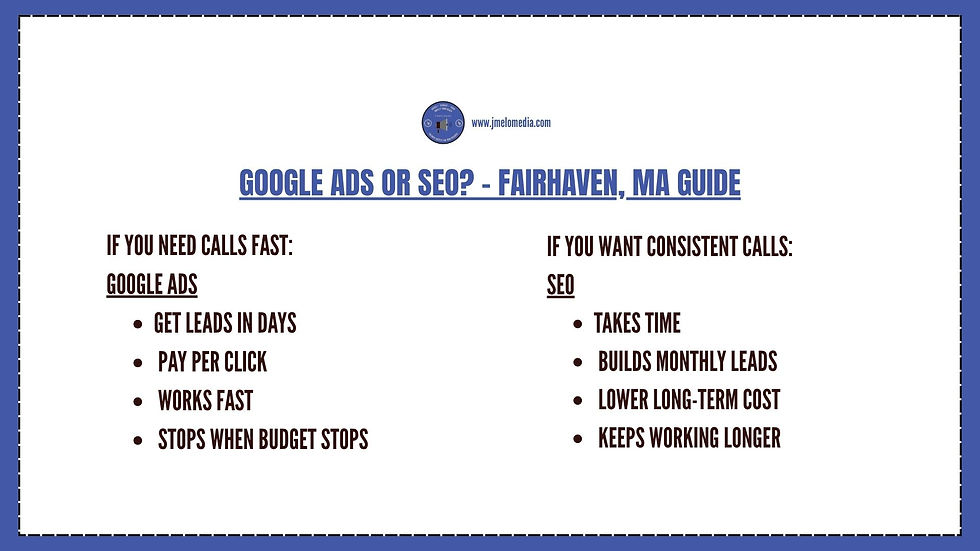
For businesses that need faster visibility, we often use paid campaigns strategically, especially when we manage projects through our SEM services in New Bedford, MA, where many companies look for quick lead flow while organic work is still taking shape.
We see the same pattern with clients supported through our SEM services in Fairhaven, MA, where early visibility helps bridge the gap before long-term rankings solidify.
As rankings begin to grow, the largest gains come from strengthening organic presence.
That’s where pairing these efforts with our local SEO services in New Bedford, MA becomes a major advantage. Businesses benefit the same way when supported by our local SEO services in Fairhaven, MA, especially in competitive service industries where trust and visibility directly affect lead volume.
Foundational steps every business should take
Every service-based business should:
Use Seo done for you if internal execution is unrealistic
Build Seo rich content with clear structure and intent
Track performance consistently
Avoid keyword cannibalization through proper planning
Without this foundation, keyword research has nowhere to land.
FAQS about keyword research
What is kd in keyword research?
KD stands for keyword difficulty. It estimates how competitive a keyword is based on existing search results.
What is the next step after keyword research in on-page Seo?
The next step is mapping keywords to pages and optimizing structure, metadata, and internal links.
Should I search for the keyword before i create a blog?
Yes. Reviewing search results helps you understand intent and content format.
How to do a proper ecommerce keyword research
Focus on product intent, category structure, and supporting content.
What is the difference between Seo and keyword research?
Keyword research informs SEO. SEO is the execution.
What is keyword bidding?
Keyword bidding applies to paid ads, not organic SEO.
Are Seo keywords case sensitive?
No. Search engines treat them the same.
Do keywords still matter?
Yes. But intent and structure matter more.
Does keyword density still matter?
No. Natural language and topic coverage matter more.
How many words in short tail keywords
Short-tail keywords are typically one to two words.
What are tripled keywords?
They are repeated variations targeting the same intent.
How to track keyword cannibalization on website
Use Google Search Console and page-level audits to identify overlapping pages.
FAQs about J Melo Media
Do you work with accounting firms?
Yes. We specialize in Seo for accounting firms and service-based businesses that value predictability and trust.
Do you only do Seo?
No. We provide website design, SEO, content, and paid advertising when it supports the strategy.
How do you approach keyword research differently?
We only research keywords we are willing to execute on.
Ready to take the next step?
If you have keyword data but are not seeing results, the issue is not research. It is execution.
At J Melo Media, we help businesses turn keyword research into rankings, traffic, and real leads. Contact us today and get a free consultation for Seo done for you.
Fairhaven, Massachusetts
508-972-1223
Sources
LinkGraph. What to Do After Keyword Research: 5 Next Steps.SEO Universe. What To Do After Keyword Research? 2025’s Full Guide.MEGA SEO. What to Do After Keyword Research: 5 Actionable Steps.SEO for Everyday. What to Do After Keyword Research: The Ultimate Guide.SEO PowerSuite. What to Do After Keyword Research: 2025 Action Plan for SEO Success.


Comments